End-to-end examples demonstrating how the OpenSense software ecosystem is applied to real-world problems, including method intercomparisons across the different packages.
CML Processing Method Intercomparison
Intercomparison of different CML processing methods.
In the cml_method_benchmarking repository we carry out an intercomparison of processing methods for CML-based rainfall estimation. for the full OpenMRG dataset (Andersson et al., 2022). This is currently work in progress and the same analysis will be added for the OpenRainER dataset. So far there are notebooks for:
Rain event detection, comparing the following methods:
Wet antenna attenuation, comparing the following methods:
Pastorek et al. (2021) (the model denoted “KR-alt” in this study is used here)
Additional notebooks are available that can be used to explore the reference data from openMRG and to derive radar data along the CMLs’ paths.
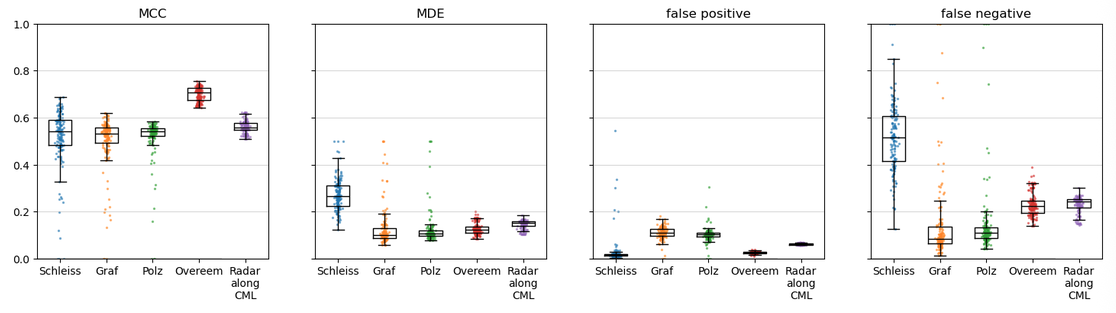
Preliminary results from the CML processing method benchmarking study, showing performance comparisons for different wet-dry classification methods. Note that these results are preliminary and a paper with the full analysis is forthcoming.
Radar Merging Method Intercomparison
Intercomparison of different methods for merging radar rainfall data with CMLs using mergeplg.
In Øydvin et al. (2025), we assessed the impact of merging commercial microwave link (CML) data with weather radar for quantitative precipitation estimation (QPE) using two openly available datasets (OpenMRG and OpenRainER) with contrasting observational densities. Multiple merging methods are compared, including kriging with external drift (KED) and a block kriging interpolation method that accounts for the line-average nature of CMLs.
Merging CML data improves radar QPE, with reductions in mean absolute error (MAE) of up to 38% on average for KED, though performance varies with rainfall intensity, distance to observations, and network density.
The merging framework and intercomparison study are openly available at https://
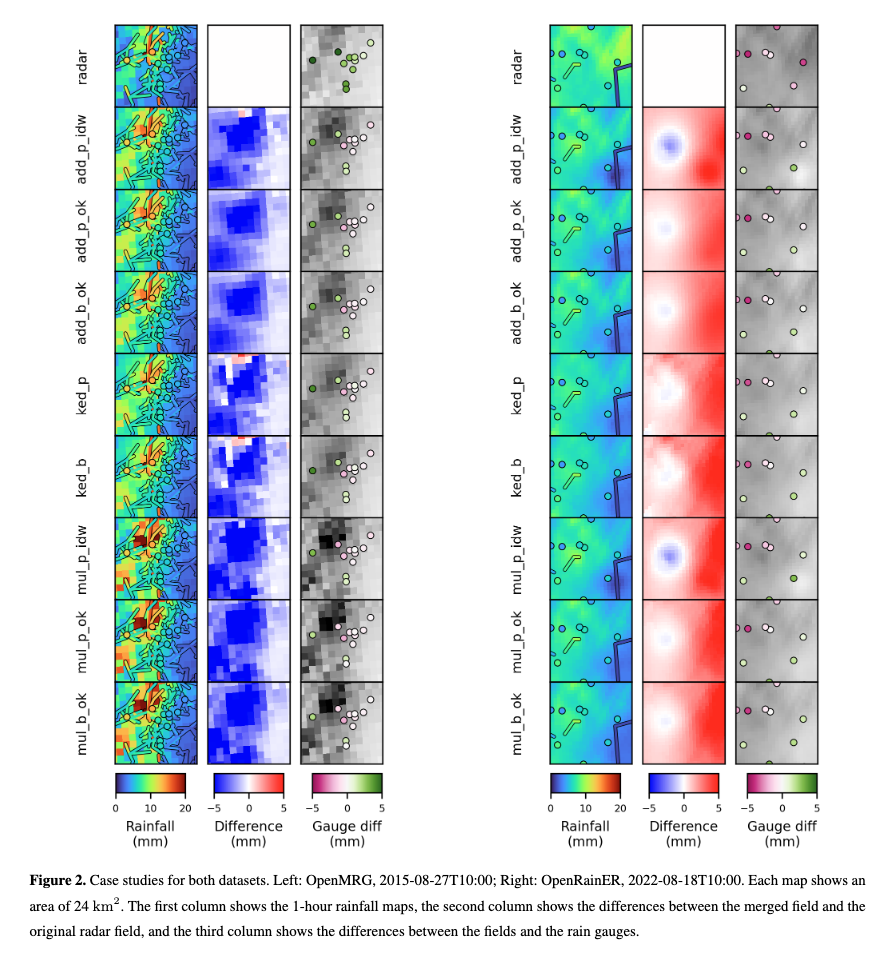
Figure taken from Øydvin et al. (2025); more details are available in the paper.
- Andersson, J. C. M., Olsson, J., van de Beek, R. (C. Z. ), & Hansryd, J. (2022). OpenMRG: Open data from Microwave links, Radar, and Gauges for rainfall quantification in Gothenburg, Sweden. Earth System Science Data, 14(12), 5411–5426. 10.5194/essd-14-5411-2022
- Schleiss, M., & Berne, A. (2010). Identification of Dry and Rainy Periods Using Telecommunication Microwave Links. IEEE Geoscience and Remote Sensing Letters, 7(3), 611–615. 10.1109/lgrs.2010.2043052
- Graf, M., Chwala, C., Polz, J., & Kunstmann, H. (2020). Rainfall estimation from a German-wide commercial microwave link network: optimized processing and validation for 1 year of data. Hydrology and Earth System Sciences, 24(6), 2931–2950. 10.5194/hess-24-2931-2020
- Polz, J., Chwala, C., Graf, M., & Kunstmann, H. (2020). Rain event detection in commercial microwave link attenuation data using convolutional neural networks. Atmospheric Measurement Techniques, 13(7), 3835–3853. 10.5194/amt-13-3835-2020
- Overeem, A., Leijnse, H., & Uijlenhoet, R. (2016). Retrieval algorithm for rainfall mapping from microwave links in a cellular communication network. Atmospheric Measurement Techniques, 9(5), 2425–2444. 10.5194/amt-9-2425-2016
- Schleiss, M., Rieckermann, J., & Berne, A. (2013). Quantification and Modeling of Wet-Antenna Attenuation for Commercial Microwave Links. IEEE Geoscience and Remote Sensing Letters, 10(5), 1195–1199. 10.1109/lgrs.2012.2236074
- Pastorek, J., Fencl, M., Rieckermann, J., & Bares, V. (2022). Precipitation Estimates From Commercial Microwave Links: Practical Approaches to Wet-Antenna Correction. IEEE Transactions on Geoscience and Remote Sensing, 60, 1–9. 10.1109/tgrs.2021.3110004
- Øydvin, E., Covi, E., Graf, M., & Chwala, C. (2025). Improving weather radar rainfall estimates by merging with commercial microwave link data: a fully reproducible, large-scale method intercomparison. 10.5194/egusphere-2025-6371